What are Community Worshops ? Value and audience
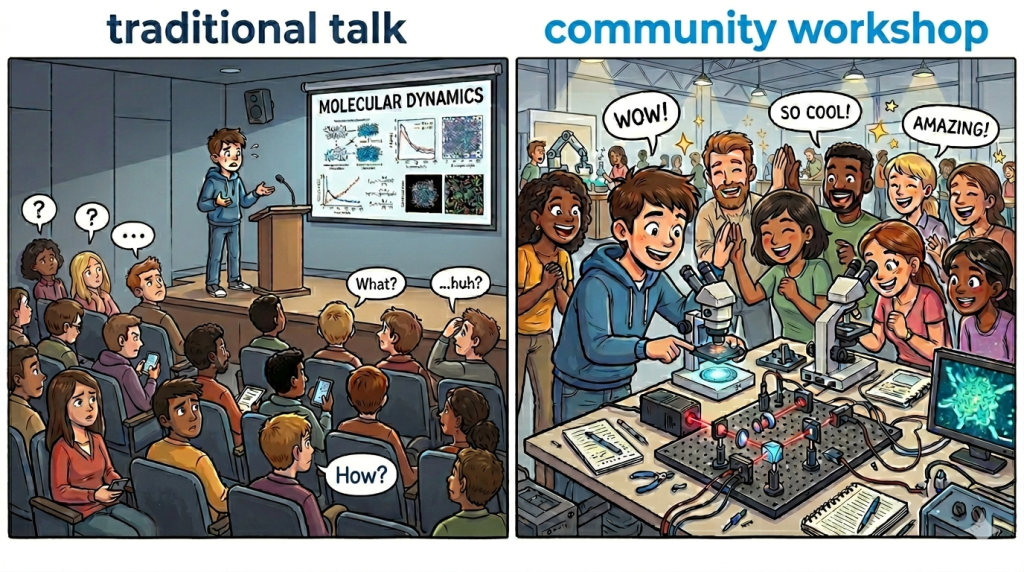
Community Workshops (CWs) have been the signature session of REMOA/SPAOM meetings since 2012. In CWs, scientists and/or technologists present scientific imaging through novel instrumentation, workflows or tools with a perspective more oriented towards practical aspects and interactivity. This includes protocols, experimental approaches, hints & tricks, open source projects or entire technological developments, with a hands-on focus and live demos when possible.
CWs promote Open Science, open source developments and community sharing and discussions. Priorities for CWs include keeping theory to a minimum, favoring active participation of attendees, a focus on instrumental/experimental practices and hands-on knowledge transfer.
Value for presenters: Organizing a community workshop positions PhD candidates and postdocs fellows as proactive leaders and experts in their field, offering unparalleled networking and visibility that far exceeds the conventional exposure of a standard talk or poster presentation.
Value for participants: CWs offer a unique opportunity to dive and get started into a topic one may not yet be familiar with, and interact extensively with experts. A single workshop can save weeks of literature search!
This year, SPAOM reinforces CWs in number and format.
Each CW will be exclusively developed around a single topic per workshop with a common format (1h15).
CWs guidelines/recommendations:
- one topic/contribution per workshop (e.g. independent subtopics are not encouraged) with a strong focus on hands-on/practical activities, and supported by interactive sessions. CWs must transfer knowledge without exclusive association to a commercial product, and should enable participants to start working on the addressed topics autonomously once they go home.
- ONE or maximum TWO animator(s) to unravel the workshop (strict limit).
- Suggested timeline (total duration 75min): short intro/theory (5’-15’), hands-on demo (15’-30’), interactive session with participants (30’-50’) with Q&A.
- [MUST HAVE] Live demo and/or interactive session: stepping out of your slides is a must !
- [MUST HAVE], at least TWO (2x) ITEMS out-of-those FOUR (4) are expected:
- Shareables: participants can access the material approached during the workshop, and take it away. Presenters can set their own rules on reusability for unpublished material or training material, but material should be shared with the participants.
- Open access: the CW deals with data, pipelines/journals, code, exercise, tutorial material etc… which is in Open-Access permanently (e.g. DOI, GitHub, etc…), ideally following FAIR principles.
- Data/results collection during the workshop: IF audience querying is key for the success of the workshop, THEN results should be made available with the participants. Data here is not restricted to experimental images: numbers, code or results of survey/discussion/exchange of good practices, input collection etc…
- Hands-on capability: Interactivity is a priority ! E.g. Time for coding by participants for image analysis tools, interactive live imaging for instruments, bring-your-own sample if possible, Touch/Make/Play on the fly if possible.
Community Workshops: Open Call
We are thrilled to announce that “SPAOM2026: Workshops edition” (In the city of Vic, Oct-6-9, 2026) has opened a call for Community Workshops .
This year, SPAOM celebrates its 10th edition and aims to increase the opportunities of community workshops (e.g. 20, more if possible) both for presenters and attendants, and to achieve this we want to attract and enable as many contributions as possible, through this Open Call.
We aim to foster an durable evolution at SPAOM meetings towards more interactive workshops, more training- and knowledge transfer-, that can be maintained in future editions. This is a call to the whole bioimaging community to make it happen!
From June 1 to July 1, any researcher/facility staff (academic, all levels e.g. PhD candidates, postdocs, imaging scientists, from anywhere) can submit a Community Workshop proposal (link below).
Submissions will be selected by the community workshop committee to ensure alignment with the workshops guidelines, a balanced program and logistical feasibility of the workshops. Please follow carefully the information below to ensure your submission matches the expected format and deadlines!
Support: Selected CW presenters (one per workshop) will be supported logistically by the organizing committee. Financial support to CW presenters is not confirmed, i.e. dependent on budget capabilities. Further information will be provided in July.
Upon selection of your workshop, your presence is expected at SPAOM 2026. The deadline for submission is 8th of July (EXTENDED), 2026 !
Suggested Topics for the Community Workshops (non exhaustive examples)
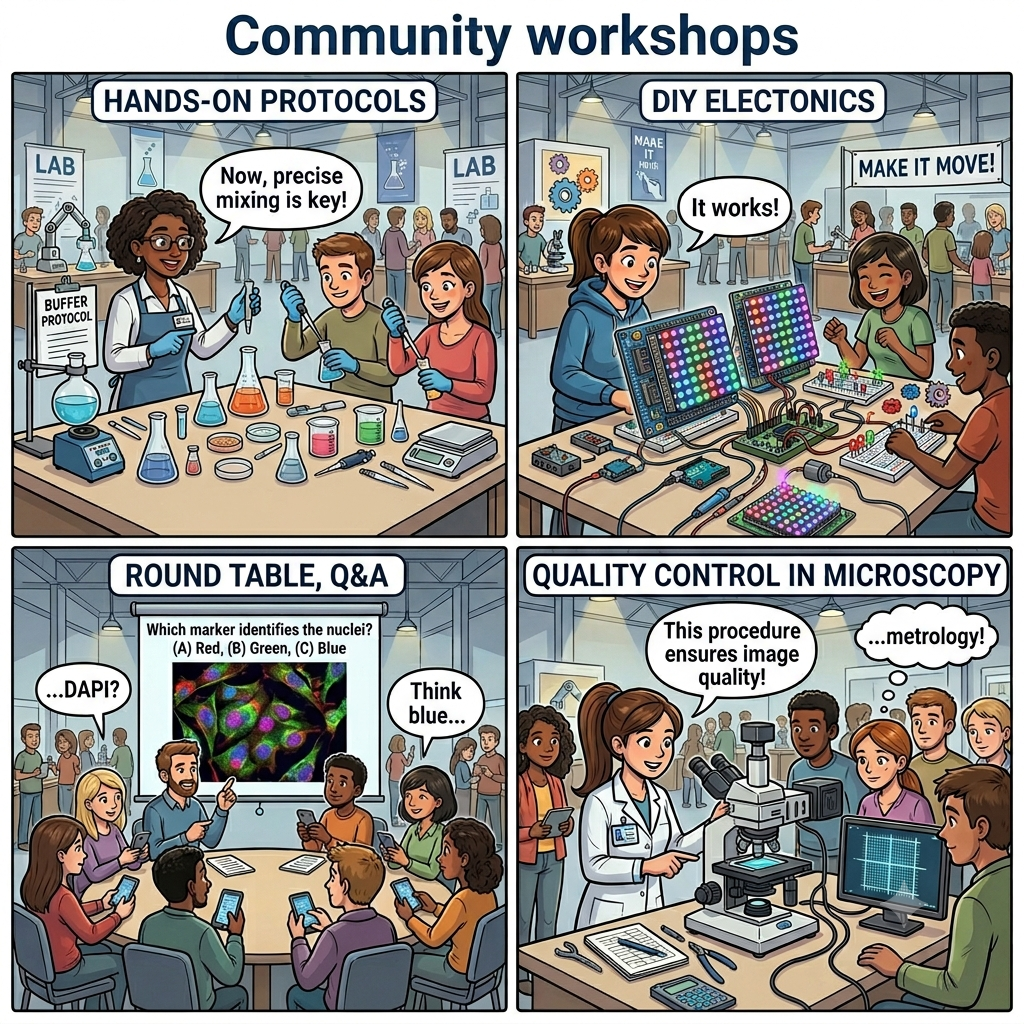
SPAOM2026 has identified the following categories to illustrate how CWs can be elaborated, and will ensure that at least one CW will be selected for each category (and more likely more than 2 for each). But any topic is welcome, even if not listed here.
| CWs category | topics | Example, it can be about … | Better not be about/with … |
| Sample Preparation | Protocols, optimization, developments, labelling, sample mounting, microfluidics-based processing, bioengineering devices. | Optical Clearing, ExM, cyclic imaging, micropatterning, bioprinting, 3D cultures, RNA/DNA based labelling, live cell dyes, fixation and preservation, biobanks… | Human cells or infectious agents (virus, S3,S4), not allowed on site. No toxic chemicals that require ventilation or secure disposal. |
| Bioimaging Technology in development | New developments/ improvements, new sources/detectors, Bioimaging in non-conventional environments | Example of topics: MINFLUX, Ultrafast imaging, isCAT, OCT, Lattice LS, label-free imaging, trending techniques, “More than 2 photons”, CLEM innovations … Can be in the form of: instruments on site (if possible!), Mock of a real instrument which allows interactivity, Interactive demo with synthetic/ recorded data, Remote connection to live instrument, An intro talk followed by interactive discussion/group work with deliverables, | A talk with scientific results: this would be more suitable to go as an abstract for a talk at SPAOM2026 |
| Bioimaging (technology) modalities | Technology-specific modalities | SIM, STED, lightsheet, QPI, Functional imaging (FLIM, FRET, etc…), HTS/HCS, whole organ imaging, SR, etc… | Same as above |
| Open Hardware | Electronics, 3D printing, open instruments, DIY, on a budget, acquisition software, hardware to improve specific workflows e.g. microfluidics, e.g. microscope inside an incubator, e.g. programming workshop on Arduino, e.g. a 3D printing workshop, etc…. | Arduino/R-Pi stuff, OpenFlexure, custom devices, software modules/framework for hardware control, a development to be applied onto a commercial instrument (if essential: explore the possibility to propose to have such instrument at SPAOM2026, organisers will try to make it happen with sponsors) | Heavily reliant on a single commercial-software or product if not justified. |
| Bioimaging workflows and applications (design, models, domains) | From sample to data, Multiple-instruments workflows, Multi-facility workflows, | Spatial -biology/-omics workflows, calcium imaging for neuroscience, multiplexed imaging, CLEM workflows, Correlative imaging, etc… | |
| Bioimage Analysis / AI | Workflows/pipelines, Machine learning, Deep learning, visualization stuff, etc… | Tutorials or advanced workflows, Fiji/Napari/QuPath/… oriented development, cell tracking environment, segmentation stuff, new libraries. | Interactivity is a must ! Showcasing without sharing code, data or similar, is not encouraged Strong dependency on a commercial software to elaborate the workshop should be fully justified |
| Bioimage Data management | FAIR concepts and data, Workflow Management Systems, IT infrastructure and distributed computing solutions, Cloud solutions, … | FAIR & DM systems (e.g. OMERO), Workflows management systems, best practices, … HPC / Cloud environments for BIAS Data handling & Storage | If you feel your workshop is more a round table than a hands-on session, SPAOM2026 has slots in the program for round tables, please submit a proposal but also get in touch with us about round tables specifically |
| Quality Control | QC can be focussed on a specific area of bioimaging. QC can deal with standards QC can deal with service quality management | QC in labelling, reproducibility of ExM/clearing, ISO in a facility service, QC in HTS/HCS, seg/tacking validation, AI validation, error estimates, Image Analysis Benchmarking,… Instruments performance/metrology (PSF, linearity, noise, …), Maintenance | A QC approach/tool demonstrated on a commercial set up is perfect, but the dependency of what demonstrated on a product/solution from a single vendor would require justification e.g. how this can be valuable for scientists that do not own it ? |
Schedule
Community Workshops will be presented TWO TIMES during the meeting (i.e., presenters will need to repeat once) to favor more participation who will have to choose between parallel workshops.
There will be 6 CWs slots for participants, with 7 to 10 parallel workshops depending on the sessions, for a target of 20 total community workshops (more if possible).
Logistics Support from SPAOM2026
Workshops will be set in the community area of the “Recinte Firal El Sucre” in Vic, an approx 1000m2 Open space where each workshop will be provided with 1 Table (2x if needed), 1x 55” Monitor to plug into a laptop or PC (not provided), and 15 chairs for participants.
Installation of workshops material by participants should in principle be happening on Tuesday 6th Oct in the morning. Workshops requiring more time for installation will be considered for later scheduling (Wednesday/Thursday). The community area is expected to have high ambient light levels (roof and side windows without shutters), hence workshops proposers with specific darkness requirements are expected to approach the issue and/or communicate specifically with organizers to work together on a workable solution.
Workshops selection
The Community Workshops committee will strive to approve workshops by mid-July and will be in contact with proposers to organize logistics.
Workshops with medium or high level of complexity will be considered !!
Proposing and unravelling a CW at SPAOM2026 is a high commitment and time investment that SPAOM highly values, hence the organizers want to support as much as possible in the task, and the committee will make every possible effort to help those ambitious proposals that may aim to unravel elaborate workshops with logistical needs, of course within the meeting capabilities. Although the ability to realize complex workshops will depend on many factors, we aim to approach all proposals objectively and we will not exclude workshops only based on feasibility. We prefer to approach proposals on a case-by-case basis.
So feel free to propose ambitious workshops !
However, proposals may be rejected based on health and safety considerations (e.g. based on evaluation biological, chemical or radiation risks).
FAQs and doubts
Examples of questions/doubts and workshops layout that would be attractive and could be considered despite the possible challenges, and will involve some level of adaptability on both sides (proposer, organisers):
- You want to demonstrate a technique/sample/whatever, but you need a commercial microscope for it, and/or you even know which model or brand: we will connect you with sponsors at the Venue and they might offer a solution (this has happened in past SPAOMs). However, the workshop should not be too restricted to an exclusive commercial option of the target microscope.
- You want to bring an optical set up with an antivibration table. It is possible! Logistics to make this happen will be highly budget-dependent and will be approached in July.
- You need a full day or more to install it: you can start from Monday 5th and we can arrange the schedule for a later workshop.
- You need complete darkness to elaborate your workshop: we’ll study solutions to reduce ambient light, although it is expected that you should value the technical requirements and propose a technical solution too.
- You want to set up a sample preparation workshop that involves critical steps with reagents and safety matters: we’ll study it, bring it on! We will try to address the issue.
- Your workshop would be much more interactive and successful if it were elaborated in two parts to enable time for e.g. samples to evolve: we can find a solution and use two slots (e.g. Part I, part II). Same with image analysis-related topics. However, using 3 slots will not be possible.
- You need all participants to code on laptops and prepare the material beforehand: we will connect you with them (registration based).
- You need live samples for the specific demo but you don’t know how to organise it: we want to help! This will be a challenge but we are willing to find ways to make it happen.
- You need live samples for your demo and you know exactly what is needed: describe it as precisely as possible in the proposal form!
- You want to do a 3D printing workshop but you’re worried about e.g. resin chemical smell etc… we’ll find a way to make it happen safely!
- You want to achieve a specific goal but in 75min you think you can’t do it alone and you don’t have a partner available yet: we can try to find a volunteer to help !
- You are not sure you can support the costs of shipping for the material you need to set up: we will study it and may propose some support. Please justify carefully any lack of resources in the proposal!
- You need basic lab equipment (e.g. fridge, freezer, vortex, pipettes, etc…): We can help you, you won’t be the only one! Please list all needs accurately.
- You would like, for example, to make a workshop on Arduinos to control a specific component, and ideally you would like all participants to have one unit to control, but you don’t have a stock of e.g. 10 identical kits to be shared: describe with accuracy what is the material needed, the quantities and we can study what solutions can be found.
Contact for inquiries
In case of doubts and questions, you can contact the Community Workshop Committee through Julien Colombelli: julien(dot)colombelli(at)irbbarcelona(dot)org